
Species-level microbial identification in minutes, for pharma, food and research labs in Bangladesh. The Autof series from Autobio identifies bacteria, yeasts and fungi from a single colony. We help you choose the right model, then install, qualify and support it with our own engineers.
What MALDI-TOF does, in plain terms
- 1SpotColony + matrix on the plate
- 2FireLaser releases the proteins
- 3FlyIons travel; light ones arrive first
- 4MatchSpectrum matched to the database
MALDI-TOF stands for matrix-assisted laser desorption/ionization time-of-flight mass spectrometry. It identifies a microorganism by reading the pattern of its proteins, which is as characteristic as a fingerprint.
- Spot — a little of a colony is placed on a target plate and covered with a matrix solution.
- Fire — a laser releases and ionizes the proteins.
- Fly — the ions travel through a vacuum tube; lighter ions arrive first, producing a spectrum.
- Match — software compares the spectrum with a reference database and reports the organism, usually to species level.
Because the result comes from the organism’s proteins rather than from biochemical reactions, identification takes minutes instead of days, and the cost per test is low once the instrument is in place.
Why QC labs move to MALDI-TOF
Environmental monitoring. Knowing which organisms appear, and where, turns EM data into a trend you can act on. Species-level ID shows whether a recurring isolate is a skin organism, a water organism or something from raw materials.
OOS and deviation investigations. When a result is out of limit, identifying the organism quickly points the investigation towards the right root cause.
Food and beverage QC. Fast identification of contaminants helps decide what to hold, what to release and where to clean.
Research and teaching labs. One instrument covers bacteria, yeasts and filamentous fungi across many projects.
Labs without MALDI-TOF often rely on slow biochemical kits or send isolates out. Both add days, and outsourcing adds a cost per isolate that discourages routine identification.
Request Quote · WhatsApp an engineer
The Autof series at a glance
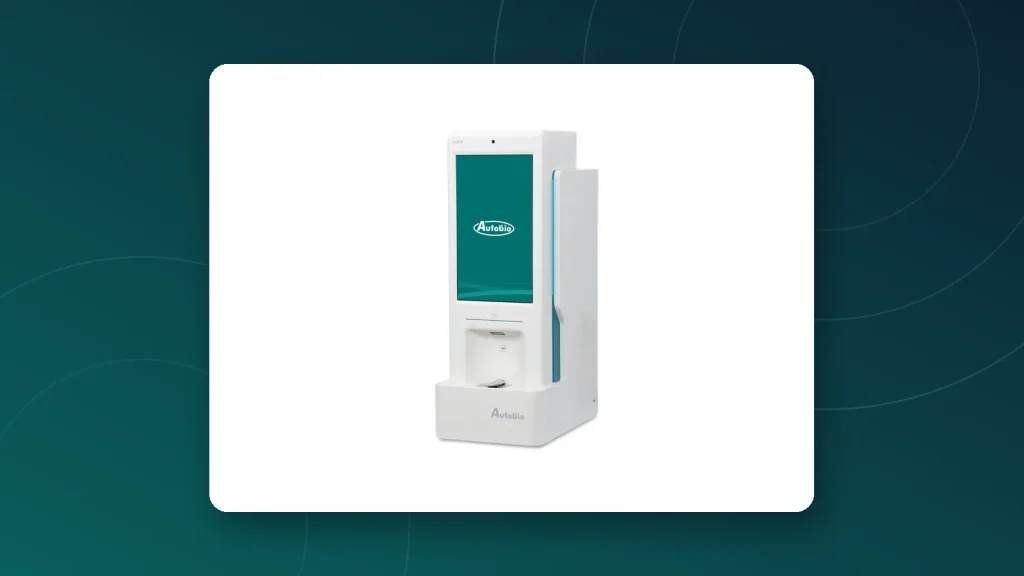
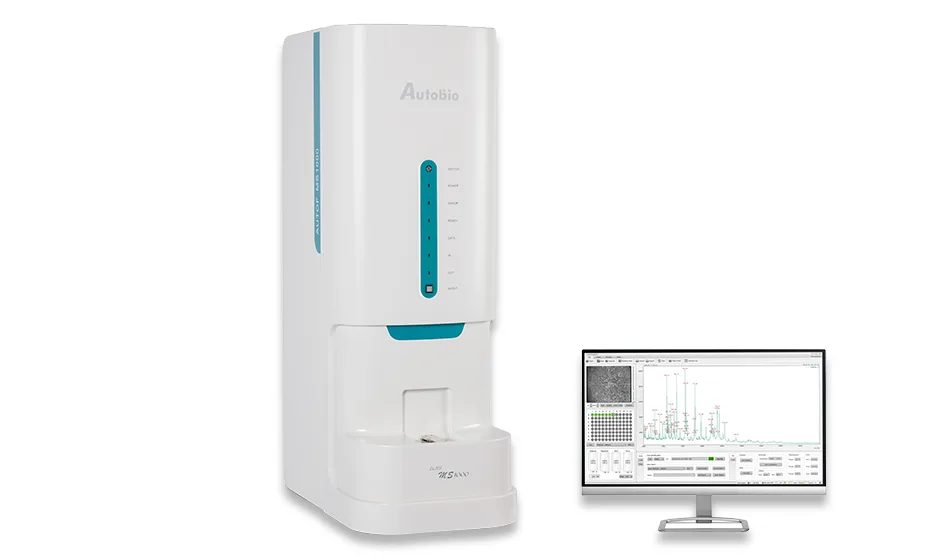
| Autof ms600 | Autof ms1000 | Autof ms2000 | Autof TX8 (T series) | |
|---|---|---|---|---|
| Positioning | Entry model | Established workhorse | High-speed model | Compact, touch-screen model |
| Laser | 337 nm nitrogen | 337 nm nitrogen | 355 nm solid-state | Solid-state |
| Speed | About 260 samples/hour | About 300 samples/hour | About 960 samples/hour; a 96-spot plate in about 7 minutes | Continuous loading: add targets as samples arrive |
| Laser life | 400 million shots | 400 million shots | 70 billion shots | Long-life solid-state laser |
| Vacuum | 1×10⁻⁷ mbar; turbo + mechanical pump | 1×10⁻⁷ mbar; turbo + mechanical pump | 1×10⁻⁷ mbar; oil-free membrane pre-pump + turbo pump | Ultra-high vacuum system |
| Size and weight | 450 × 705 × 1280 mm; 101 kg | 450 × 705 × 1280 mm; 101 kg | 450 × 705 × 1280 mm; 110 kg | About 0.17 m² footprint; 85% less bench space, 70% less volume and 50% less weight than Autof ms |
| Notable | Same database and software as the series | CE-IVD; peer-reviewed against Bruker Biotyper | Fastest plate read in the series | 18.5-inch touch screen, face-recognition login, single power cable |
All models share the Autof database (more than 16,000 reference spectra, 5,000+ species, 1,000+ genera, with a filamentous fungi library of 450+ species), single-spectrum matching in about 0.1 second, a reusable target holder with disposable 96-spot target slides, online database updates and two-way LIS connection.
Sources: Autobio product pages and brochures (Autof ms series, Autof T series). The newer Autof ms2600 has been evaluated in peer-reviewed studies (see below); ask us for its current specification.
Which Autof model fits your lab?
Choosing a MALDI-TOF is mostly about how many isolates you identify per day, how much hands-on time your team has, and how the system will grow with you.
| Your lab | What matters | Where to start |
|---|---|---|
| QC lab with a modest, steady flow of EM and OOS isolates | Reliable ID, lowest entry cost | Autof ms600 or ms1000 |
| Busy central or group lab serving several plants | Speed per plate, throughput | Autof ms2000 |
| Lab short on bench space, or isolates arriving all day | Small footprint, load-as-you-go | Autof TX8 |
The quickest way to decide is a short call: tell us your daily isolate volume, sample types and team size, and an engineer will recommend a model and send a configuration.
A typical Autof workflow in a QC lab
- Pick a colony from an EM plate, a water sample or an OOS investigation.
- Spot the target plate directly, or after a short extraction step for organisms that need it, such as some yeasts and moulds.
- Add matrix and let the spot dry.
- Load the plate into the Autof instrument and start the run.
- Review the result — organism name, confidence score and spectrum — and approve it in the software.
- Record and trend the identification alongside your EM data.
Most of the time sits in steps 1–3. That is why hands-on time per plate, and any automation of spotting, matter as much as instrument speed when you compare models.
Preparing your lab for MALDI-TOF
- Space and environment. The instrument needs a stable bench, adequate power and a controlled room temperature. We check site readiness before delivery.
- People. Name a lead microbiologist for training and for writing the SOP.
- Isolates for qualification. Keep a set of your own well-characterised EM and OOS isolates to compare during qualification.
- Database scope. Check which organisms matter most in your plant and confirm they are covered in the database version you buy.
- Records. Decide how identifications will be reviewed, approved and archived within your quality system.
MALDI-TOF or outsourcing?
- Days, including transport
- Pay per isolate
- Fewer isolates identified
- Minutes once colonies grow
- Low consumable cost per test
- Every relevant isolate
| Outsourced identification | In-house Autof MALDI-TOF | |
|---|---|---|
| Time to answer | Days, including transport | Minutes once colonies grow |
| Cost model | Pay per isolate | Instrument + low consumables cost per test |
| Effect on trending | Fewer isolates identified, to save cost | Every relevant isolate can be identified |
| Control of data | With the external lab | In your own quality system |
Outsourcing can make sense for very low volumes. As soon as a lab identifies isolates every week, the in-house route usually gives faster investigations and better trend data. We can compare both using your own isolate numbers.
Questions to ask before you buy any MALDI-TOF
- Which database version is included, and does it cover the organisms found in my plant?
- What is the hands-on time per 96-spot plate, not just the run time?
- What consumables are needed per test, and are they stocked in Bangladesh?
- Who executes IQ/OQ, and who writes the protocols?
- How are software and database updates delivered?
- Who services the instrument locally, and how are spare parts supplied?
We answer each of these in writing with every Autof quote.
What you get with every Autof system
- Installation and commissioning by Pharma Biotech engineers
- IQ/OQ executed on site by our engineers, with protocols from Autobio or Pharma Biotech
- Operator and administrator training, including target spotting and database use
- AMC option for preventive maintenance, repairs and spare parts
- Support across Bangladesh from our Dhaka team
Installation & Commissioning · IQ/OQ/PQ Validation · AMC, Repair & Spare Parts · Training
What drives the cost of a MALDI-TOF
People often search for “MALDI-TOF price”. There is no single figure, because the total depends on:
- The model and its throughput.
- The database licensed with it and any add-on libraries.
- Consumables: disposable target plates, matrix and calibration standards.
- Qualification work (IQ/OQ) required by your quality system.
- Service package: warranty length and AMC coverage.
- Site readiness: power, space and environment.
Comparing only the instrument price hides the running cost. Ask for a cost per identification over three to five years, including consumables and service. We provide that breakdown with every quote.
Request a quote with cost per test
Independent evaluations
The Autof ms1000 and ms2600 have been evaluated in peer-reviewed studies alongside other MALDI-TOF systems:
- Comparison of Autof ms1000 and Bruker Biotyper
- Evaluation of Autof MS2600 and MBT Smart
- Autof MS2600 vs Biotyper Sirius
These studies were done mostly in clinical labs. For pharma use, we recommend a short on-site comparison with your own EM and OOS isolates as part of qualification.
Proof
- Pharma Biotech is the authorized Autobio distributor in Bangladesh.
FAQ
What is MALDI-TOF used for in pharma QC?
Identifying environmental monitoring isolates, supporting OOS and deviation investigations, and building organism trends for audits.
How long does identification take?
Minutes per sample once colonies are available. Autobio rates the ms1000 at about 300 samples per hour and the ms2000 at about 960 per hour (a 96-spot plate in about 7 minutes).
Which organisms can it identify?
Bacteria, yeasts, fungi and filamentous fungi. The Autof database holds more than 16,000 reference spectra covering 5,000+ species and 1,000+ genera, plus a filamentous fungi library.
Which model should I choose?
It depends on daily isolate volume and automation needs. Share your numbers and we will recommend a model.
What does a MALDI-TOF cost in Bangladesh?
It depends on model, database, consumables and service package. We quote the instrument and the cost per identification over several years.
Who installs and supports the system?
Our own engineers install it, execute IQ/OQ, train your team and provide AMC across Bangladesh.
Can we see a demo?
Ask us. We will arrange a product presentation and discuss your samples.
Get the right Autof model for your lab
Request Quote · WhatsApp an engineer
Related: Microbial Identification solution · Rapid Microbial Testing · Autobio brand page
Get a quote for MALDI-TOF Systems
Send your requirement; an engineer replies with options and price.