
Bruker Biotyper vs VITEK MS vs Autof: what the published studies show
October 16, 2026 · 7 min read
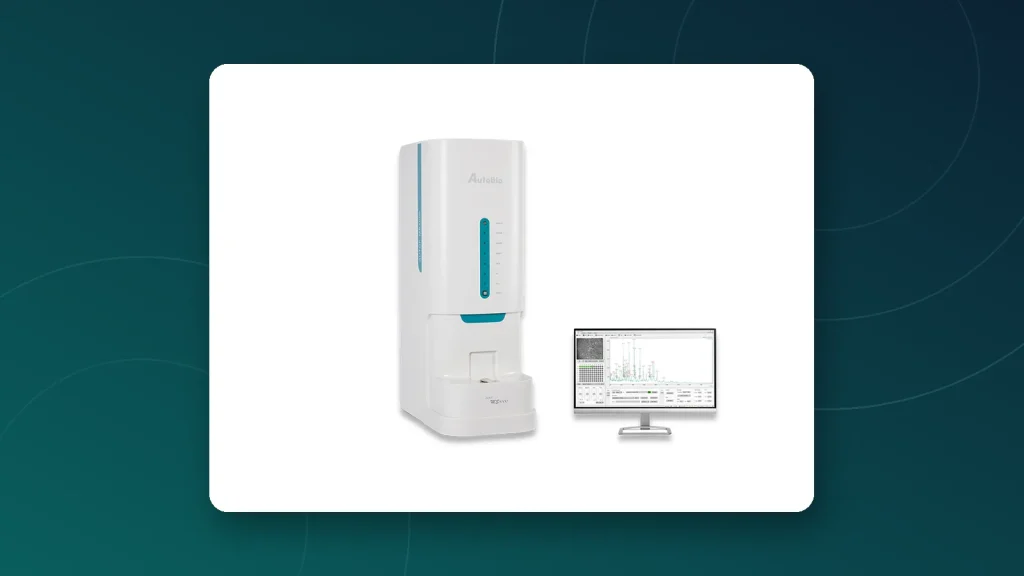
If your lab is choosing a MALDI-TOF system, three names come up most often: the Bruker MALDI Biotyper, the bioMérieux VITEK MS and, more recently, the Autobio Autof series. Brochures from each maker claim speed and accuracy, so the fairest way to compare them is to look at independent studies that tested the systems side by side on the same isolates.
This article summarises those studies in plain language, explains what they mean for a pharma or food QC lab, and lists the questions that matter more than the headline percentages. We supply the Autobio Autof range in Bangladesh, so we are not neutral. That is why every number below comes from a published, peer-reviewed study, with the source listed at the end.
The three systems in brief
All three work the same way: a colony is spotted on a target with a matrix, a laser ionises the proteins, and the protein “fingerprint” is matched against a reference library. The differences are in the hardware, the speed, the size and coverage of the library, and the scoring rules each maker uses.
What the head-to-head studies found
Autof vs Bruker Biotyper
Autof ms1000 vs Bruker Biotyper (Park et al., 2021). 507 strains were tested: 205 preserved strains and 302 clinical isolates.
- Preserved strains: correct identification at species or complex level was 97.6% for the Autof ms1000 and 97.1% for the Bruker Biotyper.
- Clinical isolates: 99.0% for the Autof ms1000 and 99.3% for the Bruker Biotyper.
- Time to analyse 96 spots: about 14 minutes on the Autof ms1000 and about 27 minutes on the Bruker Biotyper.
The authors concluded that the two instruments performed comparably, and noted the short test time of the Autof ms1000.
Autof MS2600 vs Bruker MBT Smart (De Carolis et al., 2024). 535 bacteria and yeasts were tested in parallel. The Autof MS2600 gave results comparable to the MBT Smart for bacteria, and the authors reported excellent accuracy for clinically relevant yeasts.
Autof MS2600 vs Biotyper Sirius (Piron et al., 2026). This is the largest study so far: 1,006 clinical isolates in a university laboratory in Brussels.
- Using each maker’s own scoring rules, 91.0% of isolates were correctly identified to species level by the Autof MS2600 and 95.5% by the Biotyper Sirius.
- The difference was statistically significant for Gram-positive bacteria, but not for Gram-negative bacteria.
- When the identification threshold of the Autof MS2600 was lowered, its species-level rate for Gram-positive bacteria became statistically equivalent to the Sirius. The authors stress that such a threshold must be validated first.
- Non-identifications were very low and similar on both systems, and only two discordant results were found.
The authors judged both systems to have comparable analytical and practical performance and considered the Autof MS2600 suitable for routine use.
Positive blood cultures (Brussels, 2026). In 157 bloodstream infection episodes, species-level identification directly from positive blood culture was 73.2% for the Autof MS2600 with an in-house pretreatment, 72.6% for the Sirius with an in-house pretreatment, and 62.4% with the Autobio commercial kit. The main lesson was that the pretreatment protocol mattered more than the platform.
Autof vs VITEK MS
Autof MS1000 vs VITEK MS (Arici et al., 2026). 578 clinical isolates, including Enterobacterales, non-fermenters, Gram-positive cocci, anaerobes and yeasts.
- Species-level identification: 93.3% for the Autof MS1000 and 95.5% for the VITEK MS.
- Misidentification: 1.5% and 1.4% respectively.
- The authors found significant agreement between the two systems and concluded that the Autof MS1000 gives comparable results.
Bruker vs VITEK MS
Bruker and bioMérieux systems have been compared many times over the past decade, and both are well established in clinical labs. The studies above are useful because they place the Autof on the same scale as these two reference systems.
Summary table
| Study | Systems compared | Isolates | Main result |
|---|---|---|---|
| Park et al., 2021 | Autof ms1000 vs Bruker Biotyper | 507 | Comparable accuracy; 96 spots in ~14 vs ~27 min |
| De Carolis et al., 2024 | Autof MS2600 vs Bruker MBT Smart | 535 | Comparable for bacteria; excellent for yeasts |
| Piron et al., 2026 | Autof MS2600 vs Biotyper Sirius | 1,006 | 91.0% vs 95.5% species level; comparable overall |
| Brussels, 2026 (blood cultures) | Autof MS2600 vs Biotyper Sirius | 157 episodes | 73.2% vs 72.6% with in-house pretreatment |
| Arici et al., 2026 | Autof MS1000 vs VITEK MS | 578 | 93.3% vs 95.5% species level; comparable |
What about pharma environmental isolates?
Almost all the studies above were done in clinical laboratories. A pharma QC lab sees a different mix: skin flora from operators, spore-forming bacteria, water organisms and moulds from cleanrooms. Many of these are less common in clinical libraries.
One study looked at exactly this. Ma et al. (2025) tested the Autof MS 1000 on 1,041 isolates from pharmaceutical environments, using 16S rDNA sequencing as the reference:
- 77.4% of isolates were identified with a reliable score.
- Species-level accuracy was 73.1% and genus-level accuracy was 91.5%.
- The authors saw considerable potential for high-throughput identification of pharmaceutical environmental bacteria, and recommended expanding the database and optimising pretreatment.
For moulds, Ao et al. (2023) tested the Autof ms1000 on 106 filamentous fungi: 95.3% were identified to genus or species level and 76.4% correctly to species level, with database upgrades recommended for rare strains.
What this means in practice: no MALDI-TOF library is complete for environmental isolates, whichever brand you choose. Plan for it:
- Ask each supplier how their library covers your typical environmental organisms.
- Check whether you can build a custom in-house library. The Autof database is customizable, so isolates you confirm once by sequencing can be added and recognised next time.
- Test the system with your own isolates during qualification, not only with reference strains.
Beyond accuracy: what else to compare
- 1Library coverageYour organisms, custom spectra
- 2SpeedTime per plate, continuous loading
- 3Cost per testSlides, matrix, reagents
- 4ServiceLocal engineer, spare parts
- 5QualificationIQ/OQ, own-isolate check
The studies show that the three platforms are close on accuracy for routine organisms. For many labs the deciding points are practical:
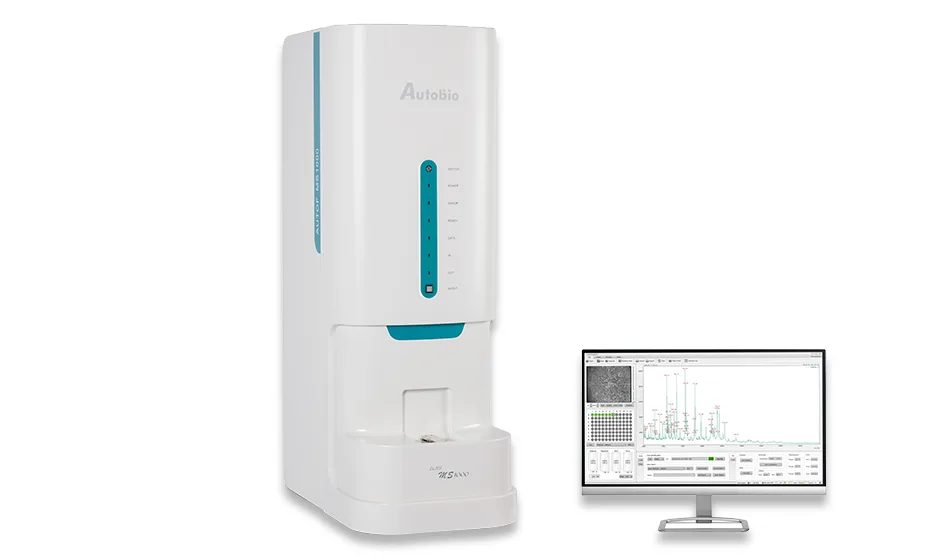
- Speed. The Autof ms1000 read 96 spots in about half the time of the Biotyper in Park et al. Autobio rates the solid-state Autof ms2000 at about 960 samples per hour.
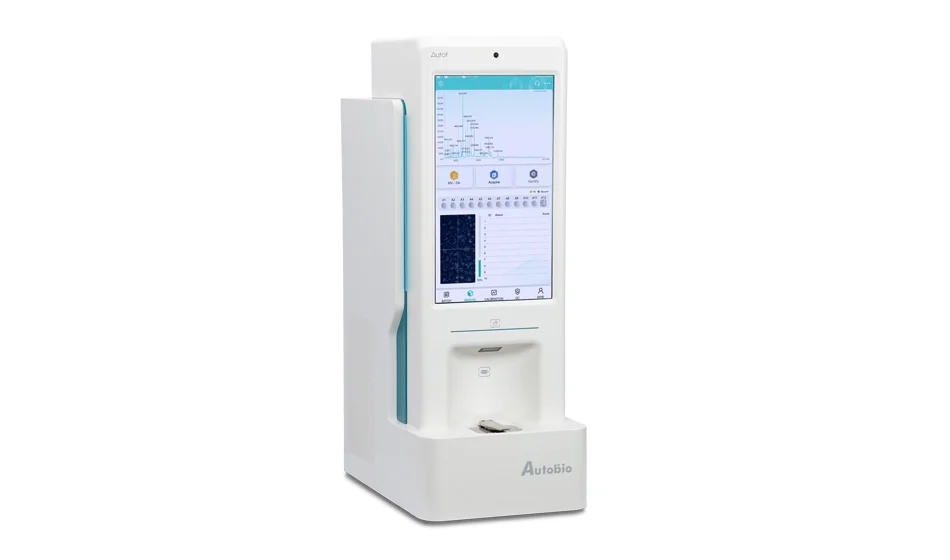
- Space. The Autof TX8 has a footprint of about 0.17 m², which suits labs that cannot dedicate a room to the instrument.
- Targets. The Autof uses a reusable holder with disposable target slides, so there is no target cleaning between runs.
- Total cost. Instrument, database updates, consumables per test and service over five to ten years. See our MALDI-TOF price guide.
- Local support. Response time, spare parts and training in Bangladesh decide how much downtime you have.
How to read these percentages
A few cautions before you compare numbers across studies:
- Each maker uses its own scoring threshold. A lower threshold gives more identifications but needs validation, as the Brussels study showed.
- The organism mix changes the result. Clinical isolates, environmental isolates and moulds give different rates on every system.
- Sample preparation matters. Direct smear, formic acid extraction and pretreatment kits all change the outcome, sometimes more than the instrument does.
- One study is one lab. Look for results that hold across several studies, not the single best figure.
Frequently asked questions
Is the Autof as accurate as the Bruker Biotyper?
In the published head-to-head studies, the two performed comparably for routine clinical organisms. In the largest study, the Biotyper Sirius identified more Gram-positive isolates at default thresholds (95.5% vs 91.0% overall).
Which is faster, Bruker or Autof?
In Park et al. (2021), 96 spots took about 14 minutes on the Autof ms1000 and about 27 minutes on the Bruker Biotyper.
Is the Autof suitable for pharma QC?
A study of 1,041 pharmaceutical environmental isolates found 91.5% genus-level accuracy for the Autof MS 1000, with database expansion recommended. We qualify the system on site with your own isolates, so you know its performance on your organisms before routine use.
Can I use a MALDI-TOF for moulds?
Yes, with a fungi pretreatment step and a fungi library. The Autof ms1000 identified 95.3% of 106 filamentous fungi to genus or species level in Ao et al. (2023).
Sources
- Park JH et al. Comparison of Autof ms1000 and Bruker Biotyper MALDI-TOF MS platforms for routine identification of clinical microorganisms. BioMed Research International, 2021. doi:10.1155/2021/6667623
- De Carolis E et al. Evaluation of Autof MS2600 and MBT Smart MALDI-TOF MS systems for routine identification of clinical bacteria and yeasts. Microorganisms, 2024. doi:10.3390/microorganisms12020382
- Piron M et al. Evaluating the Autof MS2600 vs. Biotyper Sirius MALDI-TOF MS. Eur J Clin Microbiol Infect Dis, 2026. doi:10.1007/s10096-026-05497-2
- Comparative analytical performance of Autof MS2600 and Biotyper Sirius from positive blood cultures. Eur J Clin Microbiol Infect Dis, 2026. doi:10.1007/s10096-026-05534-0
- Arici N et al. Comparison of the Autof MS1000 with the Vitek MS in the identification of bacterial and yeast isolates. Clinical Laboratory, 2026. doi:10.7754/clin.lab.2025.250430
- Ma Y et al. Evaluation of MALDI-TOF systems (Autof MS 1000) in identification of pharmaceutical environmental bacteria. J Microbiol Methods, 2025. doi:10.1016/j.mimet.2025.107309
- Ao K et al. Evaluation of the Autof ms1000 mass spectrometry for rapid clinical identification of filamentous fungi. BMC Microbiology, 2023. doi:10.1186/s12866-023-02968-w
Talk to us
Want to see how the Autof performs on the organisms your lab actually finds? Share your typical isolates and daily volume, and we will recommend a model and a qualification plan.
Explore Autof MALDI-TOF systems · Request a quote · +880 1841-589897 · +880 1711-373646