
Depth filter vs membrane filter: which one should you use?
October 16, 2026 · 6 min read
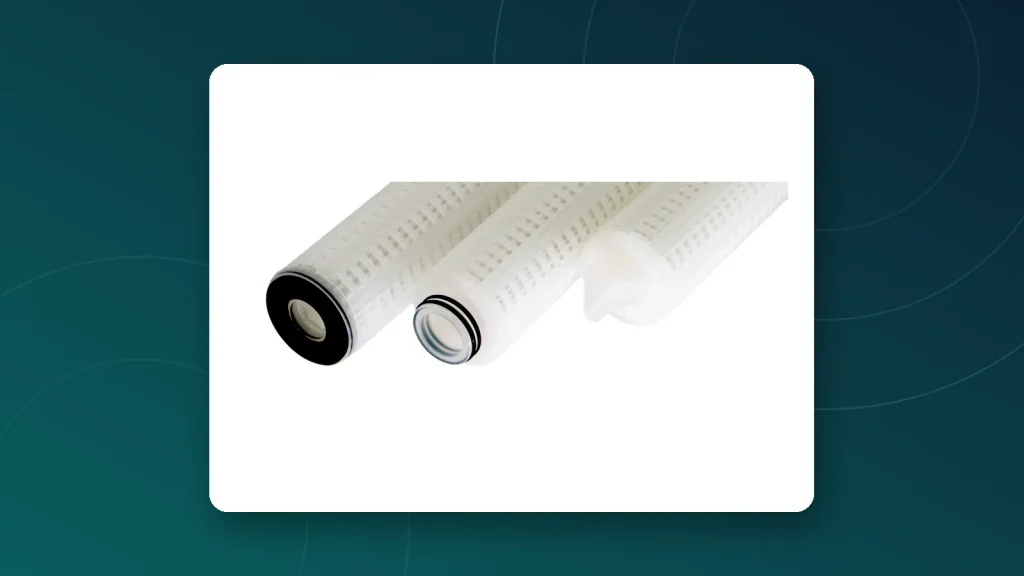
Walk through any pharmaceutical, API or beverage plant and you will find two kinds of cartridge filters doing very different jobs: depth filters and membrane filters. Choosing the wrong one, or using one where you need both, is one of the most common reasons filters clog early, cost too much or fail to protect the product.
This guide explains how each type works, what “absolute” and “nominal” ratings mean, and how to combine them into a filtration train that is reliable and economical.
The short answer
- Captures throughout the media
- High dirt-holding
- Often nominal rating
- Prefiltration, clarification
- Captures at the surface
- Low dirt-holding
- Absolute rating
- Final and sterilizing filtration
- Depth filters trap particles throughout the thickness of the media. They hold a lot of dirt and are used for prefiltration and clarification.
- Membrane filters act like a precise sieve at the surface. They give a defined, absolute cut-off and are used for final and sterilizing filtration.
Most well-designed processes use both: depth filters upstream to take the dirt load, membranes downstream to guarantee the final quality.
How a depth filter works
A depth filter is made of a thick, tangled matrix of fibres — for example meltblown polypropylene, wound yarn, polyester or glass microfibre. As liquid flows through, particles are caught at many points inside the media:
- large particles are caught near the outside;
- smaller particles travel further before they are captured;
- some particles stick to fibres by adsorption.
Because the whole thickness does the work, a depth filter can hold a large amount of dirt before the pressure drop becomes too high.
Types of depth cartridges
- Meltblown — fibres blown into a graded structure; low cost, good for general particle removal. Global Filter’s GATB, GCTB, GRTB and GWTB series are examples.
- Wound — yarn wound around a core; used for coarse prefiltration (Global Filter G Series).
- Pleated depth — depth media folded into pleats, packing more area into the cartridge for higher flow and dirt capacity (Global Filter PP-Series, polyester and FG microglass).
- High-flow — large-diameter pleated depth cartridges for very high volumes (Global Filter HFB-Series).
Where depth filters fit
- Prefiltration ahead of a membrane
- Clarification of liquids and syrups
- Removal of activated carbon or catalyst fines
- Water pretreatment
- Point-of-use particle removal
How a membrane filter works
A membrane is a thin, continuous layer of polymer with pores of a controlled size. Particles and microorganisms larger than the pore rating are held at or near the surface; smaller ones pass through. Because the pore structure is defined, the retention is predictable.
Common membrane materials
| Membrane | Character | Typical use |
|---|---|---|
| PES (polyethersulfone) | Hydrophilic, wets easily with water | Sterilizing filtration of aqueous solutions (0.2 µm) |
| Nylon | Hydrophilic, broad chemical compatibility | Solvents and mixed solutions |
| PTFE | Hydrophobic, repels water | Tank vents, compressed air and gases, aggressive solvents |
| Polysulfone | Hydrophilic or hydrophobic versions | Sub-micron polishing |
Global Filter offers all of these, with absolute ratings down to 0.05 µm in its GPFA series.
Where membranes fit
- Sterilizing filtration of injectable solutions, buffers and water, typically at 0.2 µm
- Final polishing of process liquids
- Vent and gas filtration with hydrophobic membranes
- Solvent filtration where a precise cut-off is needed
Absolute vs nominal ratings
Filter ratings are one of the most misunderstood parts of filtration.
- An absolute rating means the filter retains essentially all particles at or above that size under the stated test conditions. Membranes are absolute-rated; some depth filters (such as Global Filter GATB) also carry absolute ratings.
- A nominal rating means the filter retains a large percentage of particles at that size, but some can pass. Many general-purpose depth filters are nominally rated.
Two filters both labelled “5 µm” can perform very differently if one is absolute and the other nominal. Always compare how the rating is defined.
Side-by-side comparison
| Depth filter | Membrane filter | |
|---|---|---|
| How it captures | Throughout the media | At the surface, by pore size |
| Dirt-holding capacity | High | Low |
| Retention | Often nominal (some absolute) | Absolute |
| Typical role | Prefiltration, clarification | Final and sterilizing filtration |
| Cost per cartridge | Lower | Higher |
| Sensitivity to heavy dirt | Tolerant | Clogs quickly if unprotected |
Building a filtration train
The most economical way to filter is to let cheaper depth filters protect more expensive membranes. A typical train looks like this:
- Coarse prefilter — wound or meltblown, to remove large particles cheaply.
- Fine prefilter — pleated depth, to remove smaller particles and protect the membrane.
- Final membrane — for example 0.2 µm PES for sterile filtration.
- Vent filter — hydrophobic PTFE on tanks, so air entering the system does not bring contamination.
When the train is right, the final membrane lasts much longer, change-outs are fewer and the total cost of filtration falls, even though more cartridges are installed.
Signs your train needs a rethink
- The final membrane clogs within days.
- Pressure drop rises quickly after each change-out.
- You change expensive cartridges more often than cheap ones.
- Integrity tests fail after short use.
Integrity testing: why membranes need it
A sterilizing membrane is only as good as its integrity. A damaged seal, a pinhole or a wrongly installed cartridge can let microorganisms pass without any visible sign. That is why pharmaceutical users test membrane filters for integrity, typically before and after use, following their validated procedures.
The most common non-destructive tests are:
- Bubble point — the pressure at which gas forces liquid out of the largest pores; a lower-than-expected value suggests a defect.
- Diffusion (forward flow) — the gas flow through a wetted membrane at a set pressure; a higher-than-expected flow suggests a defect.
- Water intrusion — used for hydrophobic membranes such as PTFE vent filters.
The acceptance values come from the filter manufacturer’s documentation for that specific cartridge, which is one more reason documents matter when you buy. Depth filters are not integrity-tested in the same way, because they do not claim an absolute sterilizing cut-off.
Common filtration mistakes
Using a membrane as a prefilter. Membranes clog quickly with heavy dirt. Put a depth stage in front.
Mixing up absolute and nominal ratings. A nominal 1 µm depth filter is not a substitute for an absolute 1 µm membrane.
Choosing a hydrophilic membrane for a vent. Water-loving membranes can wet out and block air flow. Vents need hydrophobic PTFE.
Ignoring chemical compatibility. Solvents and high temperatures can weaken some media and seals. Check compatibility before installation.
Changing cartridges on a calendar only. Monitor pressure drop; change when the data says so, within your validated limits.
How to choose: a checklist
Before choosing any cartridge, gather:
- The fluid — water, solvent, syrup, API solution, gas.
- Temperature and any sanitisation or steaming.
- What must be removed — particles, gels, carbon fines, microorganisms.
- Required rating and whether it must be absolute.
- Flow rate and acceptable pressure drop.
- Cartridge size and end cap, and your existing housing.
- Documents QA needs for validation.
With these details, the choice between depth and membrane — and the right sequence of both — becomes straightforward.
Frequently asked questions
Can a depth filter be used for sterile filtration?
No. Sterilizing filtration requires a validated membrane, typically 0.2 µm. Depth filters protect that membrane.
Is a smaller micron rating always better?
No. A rating smaller than you need adds cost and pressure drop without benefit. Choose the rating the process requires.
Why do membranes clog so quickly in my process?
Usually because there is no adequate prefilter. Adding a pleated depth stage upstream often solves it.
What filter should go on a tank vent?
A hydrophobic PTFE membrane, which lets air through but keeps liquids and microorganisms out.
Get help choosing
Send us your fluid, flow rate and existing housing, and we will propose a Global Filter train for your process.
Explore Filtration · All cartridge filters · Request Quote · +880 1841-589897 · +880 1711-373646